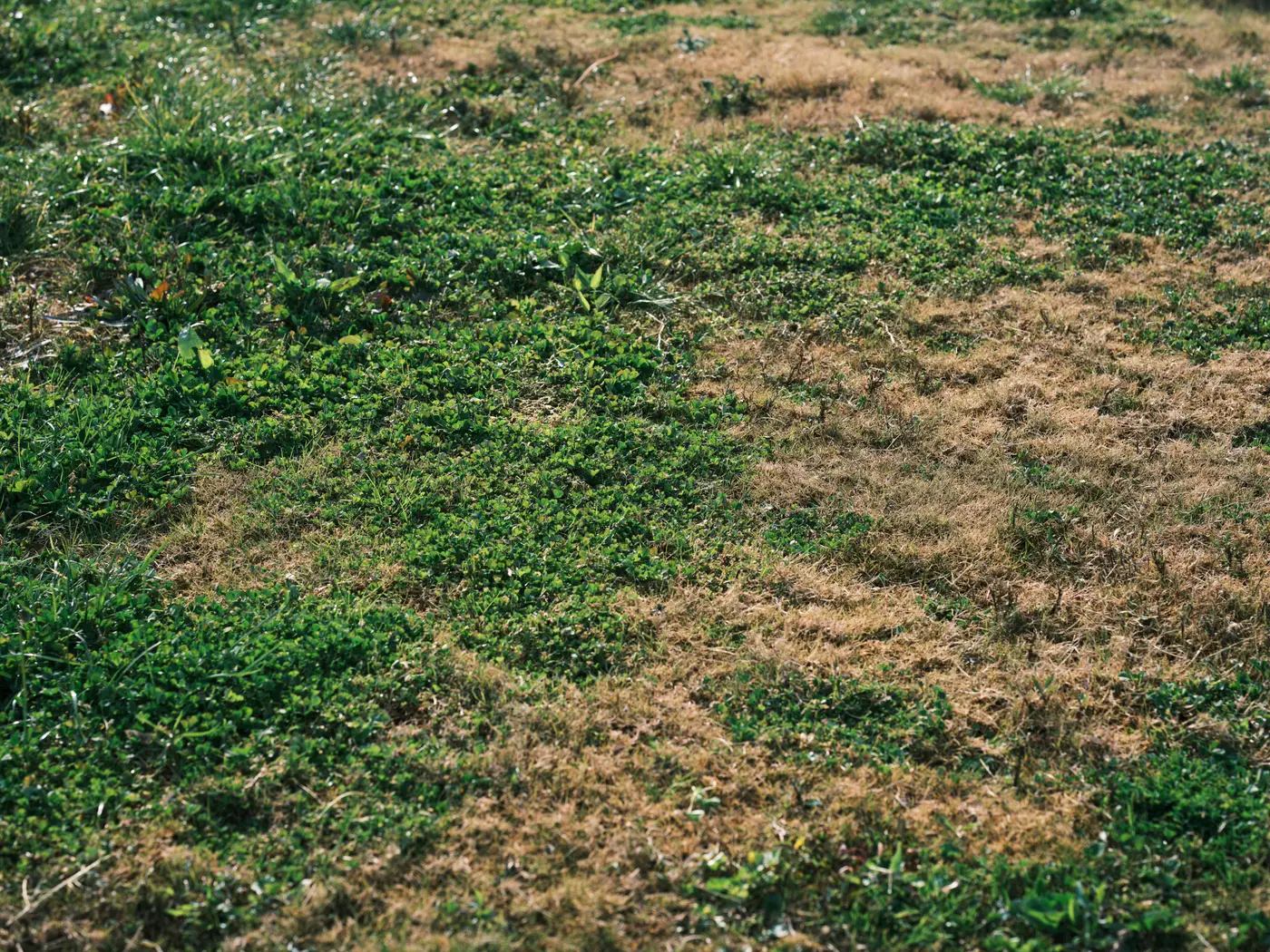
Every fall the cover on a capped cell goes brown. Every dry summer it goes brown again, earlier and in odder patches. Grass on a cap is stressed on a schedule, and most of what you're seeing is that schedule running its course, not something underneath it. The trick is knowing which patch is which.
What normal die-back on a cap looks like
Seasonal die-back follows the cell, not the cap. Cool-season fescue blends brown off top-down and tip-first, starting at the leaf edges, and they do it roughly together across a side slope, because they're all responding to the same drop in temperature or daylight. Drought stress is similar in cause but rougher in pattern: thin cover soil over the cap dries out faster than the native ground around it, so you'll see the cell go stressed before the surrounding buffer does, and south- and west-facing slopes go first because they bake hardest. Both show up as a broad, gradual change across weeks, and both recover on the next rain or the next green-up, more or less on schedule for your climate zone.
None of that is a cap problem. It's cover soil doing what cover soil does when it's six inches to two feet thick and sitting on a geomembrane that doesn't let water through from below. The vegetation has no deep moisture to draw on the way it would in native soil, so it runs hot and dry a little faster than everything else on the property. If you've got a few seasons of record for the cell, you can usually eyeball this: the brown shows up in the same general areas, at the same time of year, and it fades the same way it did last time.
What a real signal looks like against that background
A cap integrity problem, whether it's gas migration finding a path through a thin spot, a settlement crack letting moisture in, or erosion exposing cover soil on a slope, tends to break the pattern instead of following it. The tell is usually localized and out of season: a patch that stays green and then suddenly goes stressed in the middle of the growing season when everything around it is fine, or a strip that stays stressed through a rain event that greened up the rest of the slope. Gas migration in particular tends to show up as a tight, roughly circular or linear zone that tracks a known pipe run or a seam in the liner, not a broad slope-wide fade. Settlement cracking shows up as a line, sometimes following a slope contour, sometimes cutting straight across one.
The other giveaway is timing relative to rain. Drought stress and seasonal die-back both respond to precipitation on something close to a normal lag. A patch that stays brown two or three weeks after a soaking rain, while the rest of the cell has clearly recovered, is worth a closer look. That's not what drought does.
Why false positives are the default, not the exception
On any given quarter, most of the stressed vegetation you'll see on a cap is going to be seasonal or drought-driven. That's just the math of a cover system that's thinner and drier than the ground around it. Treating every brown patch as a dig-and-check event burns time and budget fast, and treating none of them that way is how a real problem sits for two more quarters before anyone notices. The useful habit is comparing against the cell's own history: does this patch match where it's browned before, at the same time of year, for the same reason? If yes, it's probably weather. If a patch is new, off-season, or doesn't track with rainfall the way the rest of the slope does, that's the one that earns a closer look, maybe a gas probe reading or a walk-down with the closure plan in hand.
That comparison only works if you're actually building a record of the cell quarter over quarter, not just eyeballing it once a year during the annual inspection. Landfill Cover Monitor is a pilot program built around exactly that kind of record: a quarterly multispectral read of vegetation stress across your capped cell, flagged against prior quarters so a change has something to be measured against. If you're trying to separate the brown that's just the season from the brown that's trying to tell you something, that's the comparison worth building.